The Boxes
Two more brandings had gone through the chute since the morning my father set his cup on the fence rail and told me the math on Soren’s knees. A new lead stood at the head of the harness team now, a bull broad enough that the buckles still hadn’t found their permanent holes. Soren himself was two summers gone, sold on the spring after that conversation to the lighter operation my father had promised him. Nobody said more about it than that. He simply wasn’t in the traces one Monday, and by Wednesday the team pulled clean without him, the way a river closes over a stone that’s been lifted out.
I was packing for the city.
My room came apart in an afternoon. The shelves that had held a childhood’s worth of found things, the desk, the bed I’d slept in since I outgrew the crib down the hall, all of it going down to bare furniture and boxes taped shut and stacked by the door. Outside the window the morning ran exactly as it had run every morning of my life: the whistle, two short blasts and then one long, the crews filing into the south yard, the water carrier’s rolling gait cutting the groove he’d cut for years. The ranch didn’t slow to notice me leaving it. It never had reason to.
At breakfast my father had the ledger open beside his plate, as it was every morning, reading the overnight numbers with the close attention other men gave the weather.
“City stock for city work,” he said, not looking up. “You don’t put a field bull in an apartment. You’ll buy city-broke there. Small frame, quiet, house-trained.” He turned a page. “A slave fits its operation or it fits nothing.”
My mother echoed him in a warmer register, buttering toast, the voice she’d always used for the trucks pulling out before dawn. “You’ll find someone lovely once you’re settled, sweetheart. There’s no rush.” Different words. Identical content. The certainty that wherever a thing ended up was where it had always been going.
I almost asked about the big bull from the west line.
I got as far as opening my mouth. What stopped me wasn’t feeling, or not only feeling. It was arithmetic. I heard the question through my father’s ears before I’d finished forming it, and the number that came back was wrong. A field bull in a fourth-floor walk-up. A body built to haul timber, standing in a room with no yard, no crew, no work to spend itself on. The request died as a bad sum before it ever reached my mouth, and I closed it again and reached for my coffee instead.
My father had been watching me not-ask. He set the ledger down and picked up where the silence had left off, as if I’d finished the sentence out loud.
“The big one’s curve has turned,” he said. “The book shows it. Wide frame, deep grooves, and the stride’s shortening its usual quarter-inch a season.” He looked at me over the rim of his cup. “You’re going through the market anyway. Take him in the truck and sell him on your way. Consider it your last job for the ranch.”
I said I would.
What I felt, sitting there with the toast going cold and the boxes stacked in the hall behind me, was pride. Not the raw kind I’d have felt as a boy shown something new, but the settled kind, the kind that comes when a man hands you a scale and doesn’t ask to see the reading. My father was trusting me with a disposal. It was, I understood without being told, a man’s job, and the fact that he’d given it to me without instructions was the certificate itself. Nobody was going to stand at my shoulder this time.
The Loading
The handler brought him up from the barracks the next morning, before the light was fully up, and I saw him close for the first time in a season.
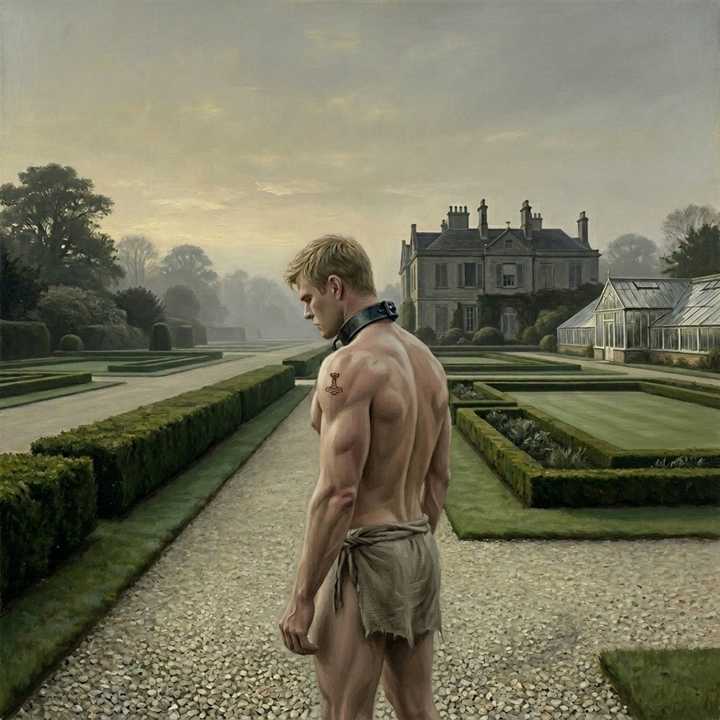
The appraisal ran itself now, automatic, without my choosing to run it. The shoulders were still the widest on the ranch, wider than I remembered them being wide, the collar’s groove worn so deep into his neck it looked less like wear than architecture, the bone shaped around the iron rather than the other way. The strap ledger crossed his back in the pale lines the years always left. The chest grooves that had been shallow when I first put my palm against them in the field were deep now, two channels I could have laid a finger into, the kind of mark only years of repetition leave, patient and total. In the overseer’s book, the commendation column that used to repeat his number like a heartbeat had gone quiet. The last entries weren’t praise anymore. They were rotation notes.
Navek loaded himself. No prod, no hesitation at the ramp. One foot found the bed and then the other, the whole frame rising and tipping its weight forward, the springs taking him with a single low give before they settled. He turned to face the cab, and the turn brought the rest of him into view the plain way it always did on an animal that had never once been given cause to cover itself: the sack swinging low and heavy as his hips came around, the cleft opening for a half-second under the shift of muscle in his back, nothing hidden because nothing had ever needed to be.
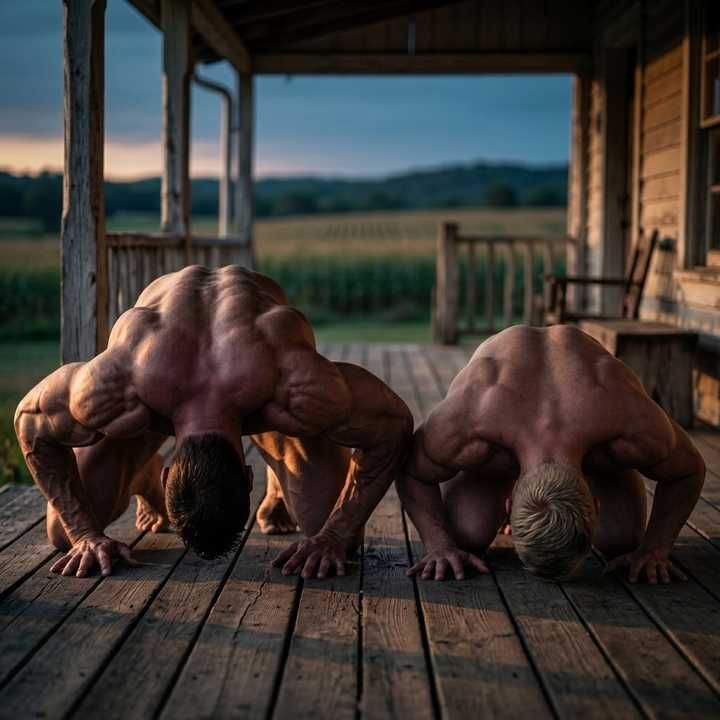
Then he was down, knees finding the ridged bed as they’d found the field dirt the first morning I ever walked out to the north line toward him, forearms crossed, chin low. The bed took his weight as the yard always had. As a fact, not an event.
I strapped my boxes in beside him. Everything leaving the ranch that morning left in one load, and there was a weight to that I let ride without turning to look at it straight on, the largest body on the ranch and the sum of my childhood riding out through the same gate on the same truck bed.
I drove. The body that had carried me across the yard as a boy, the spine I’d sat astride back when my legs didn’t reach halfway down the width of it, now rode behind me instead, and I noticed the inversion for about as long as it takes to notice a word you’ve used a thousand times suddenly looking strange on the page.
At the gate I checked the mirror once. His eyes were open, fixed on the road unspooling behind us, on the ranch shrinking into the frame and then out of it. I filed it under an animal riding calm. There wasn’t a better place to file it, and I didn’t look for one.
The drive was long and mostly silent, the engine and the tires and nothing else. I had never left the ranch for longer than a market day, and the country outside it went past with the mild curiosity of a man leaving a solar system.
The Pens
The regional market sat where it had always sat, the yard my father had walked me through as a boy, before intake, before I understood what any of it meant. I backed the truck to the seasoned pens, away from the panic and the chain-link squares where the fresh stock stood with their eyes still scanning for exits that weren’t there.
The clerk ran his hands over the collar and read the tag into his ledger. Fourteen. Written down, he had only ever been a number, the one the overseer’s book had run three weeks straight for highest volume on the fence line, and now it sat on a clipboard between a weight and a price.
In the pen, Navek did what seasoned stock did. He presented. Feet set, back flat, weight square, the posture the ranch had taught him years ago aimed now at strangers who’d never taught it to him at all. I read it with the flat, practiced approval I’d have given any well-turned-out animal. Good stock shows itself. It doesn’t need reminding.
A buyer in a canvas coat ran a hand down the strap ledger on his back and asked whether he’d been used for teaching.
“He has,” I said. “We run green stock under him. Puts them at ease faster than a handler can.” I described it in the flat cadence of any process worth its line in a sales book. The receive posture, easy to hold, the back flat enough to take a green mount without buckling under it. The hole worked open years back and still tight enough to be worth a green cock’s first go at one. The groan that came up out of that chest when the pup finally got himself seated.
The buyer’s hand had wandered down off the strap ledger to the hip while I talked. Under it the muscle went tight for a beat and let go again before his fingers could think to ask why. Navek was standing close enough to hear every word of it, and neither of us had any reason to account for that, so I kept going. The hips broken to push back and meet the drive. My own hand setting the beat on that same hip until the boy found it himself. The finish, the pup spending into him and pitching forward across the scarred width of the shoulder, shaking, done, and the shoulder taking the weight without shifting under it.
I gave the buyer the whole scene like a stud-book entry, flat, complete, no part of it left out because no part of it was the point. The point was reliability under load.
The buyer nodded along like a man pricing a well-broken mount. If anything in my own chest answered the telling, and something did, low and unhurried, it went into whatever column held everything else at the rail that morning. Salesmanship. A man selling stock well is a man who believes in the stock, and belief runs warm.
Other hands moved down the line after his. Knees checked, grooves read, teeth counted. I stood where my father had always stood at market, at the rail, in plain sight, the presence that made the stock hold its posture without a word spoken to it. I noticed, only once it was already a habit, that nobody had told me to stand there. I just did.
The Pitch
The serious offer came from a man who ran a small hauling yard attached to a market garden on the near side of the county line. Broad through the gut, sun-cured, a ledger of his own tucked under one arm like it had grown there. Two carts, short circuits between the beds and the road, no call for field speed or a full team. My father’s lighter operation, made literal, down to the garden gate.
He walked the length of Navek twice before he said anything, thumbs hooked in his belt, a man who’d already made up his mind and was in no hurry to say so. He crouched at the left knee and ran two fingers down the tendon, the same knee my father had read from the fence rail two summers before. “Curve’s started,” he said. Not a question.
“It has,” I said.
The pitch came out of me whole, in my own voice, no seam where my father’s sentence ended and mine began. The grooves are as deep as they’ll get. Keep a body past that point and every morning the leather tells him he’s less than he was. A slave is happy when he gives. A body that can’t give anymore isn’t resting. It’s dying of the difference. I laid the four clauses out in order, watched them land on a stranger the same way I’d once watched them land on me, and moved straight to the number.
He countered low, testing. While he waited for my answer, his hand found the sack and stayed there, weighing it without once looking down, a man thumbing a set of keys while his mind ran somewhere else. Two fingers hooked under the collar next, testing where the iron met the neck. He wasn’t checking anything. He’d already decided. His hand had just found somewhere to be while the rest of him did the math. I held the book’s number and didn’t move off it. He looked at the width of Navek’s shoulders once more, weighed it against his own opening, and came up the rest of the way without much more argument, a haggle that settles itself in one man’s eyes before his mouth catches up.
I sold him.
Something moved under the number, quick and low, no different from what a man feels handing off a good truck, or a dog that’s earned its keep. Not loss. I let it pass.
The number landed exactly where the book had said it would land, and the draft went into the ranch’s account before I’d finished folding the paperwork. I put it in my jacket pocket with the mild, complete satisfaction of a job carried out to standard, start to finish, no part of it requiring a second opinion.
The Boot
The transfer happened at the buyer’s trailer, parked at the far end of the lot with its ramp already down. The lead rope changed hands. There was nothing left for either of us to do beyond that.
Navek knelt at the handover in the trained posture for a change of ownership, at the new Master’s feet, mouth lowering toward the leather of a boot. The buyer took it as the routine it was, barely glancing down.
For half a second, unremarked, it was my boot he knelt nearest. The kneel had already started before the buyer’s foot had fully settled, and there was a beat, brief enough that I couldn’t have sworn to it after, where the head could have gone either way. Then the training resolved it, as it resolved everything. The mouth found the buyer’s boot instead. Property greeting its owner. The system routed around me as cleanly as if I’d already left the lot.
I put my hand on his skull one last time. The same gesture from the barn. The bone was warm through the stubble and gritty with the day’s dust, and the collar shifted in the groove it had worn for itself. In my own ledger this wasn’t a farewell. It was a handler settling stock before transport. The head took the weight and gave nothing back. Nothing was ever returned.
He loaded into the stranger’s trailer himself, unprodded, no hand required at his back, just as he’d loaded into my truck that morning. The last I saw of his eyes they weren’t on me. They were on the cart harness hanging inside the trailer door, coiled leather on a hook. I thought of my father’s hands years before mine, of Navek himself as a boy asleep on the mat at the foot of my father’s bed, called the softest hands on the ranch back then, and of whatever else those hands had ridden out of him while he was still young enough to be called that. Some things I left uncounted.
The trailer pulled out first. I watched it to the road, and caught myself checking the stranger’s tie-downs like they were my own, a habit of ownership that took its time letting go.
Then it was gone, and the lot was just a lot, dust and gravel and the smell of diesel cooling in the sun.
The Road
I drove on toward the city with half the truck bed empty behind me, the boxes sliding an inch on the turns where his weight used to hold them still.
I think of that day now more than I think of almost anything else from the ranch, in full, from a distance, the only place in this account where I let myself do that. What left the ranch that morning was one student, one draft written to an account, a stack of boxes, a folder of paperwork. The ledger balanced. Everyone ended up exactly where their function had always been sending them. My father would have called that a good day. When I told him about it that evening on the phone, he did.
The apartment had room for one more than the furniture needed. Somewhere in the drive I was already running the numbers on it. A slave of my own this time, a fresh boy trembling with the rawness every fresh one carried before the first weeks wore it out of them, the training mine to run start to finish. Ownership from the ground up, as it always was. The sum could wait. There would be time.
I never said the name out loud. Not that day, standing at the trailer with the buyer’s hand already on the rope, and not after, not once, in all the years since. There was never anyone it belonged to. It hadn’t been the bull’s name. The bull had a designation, and the designation went with the papers to a garden yard I never saw and never asked after. The name had only ever been mine, kept where I’d kept it since I was a boy at the north fence with a stick in the dirt, the way you keep a word for a mountain that’s since been quarried down to gravel and sold off by the truckload. The mountain is gone. The word still means the shape that isn’t there.
The highway ran on ahead of me, asphalt the whole way to the city, and somewhere past the county line I noticed it doesn’t take a track. The ranch roads always had. Nothing that passes over it leaves a mark behind. I remember noticing that, and noticing that I preferred it that way. I didn’t look for the reason.