I will not give you my name.
I had one twenty-five years. A north-coast name, a sailor’s name, my mother’s. I left it on the dock at Valcourt with the rest of what a free man thinks he owns. A name is for a man who can keep things. I kept nothing. So it is gone. You will not miss it. Most days, neither do I.
I count my life from the block. Whatever stood on the dock, I have stopped defending it.
Begin there, then. Maitland & Roe.
I know that street now. Not from before. From after: from the years I would spend running Valcourt in harness, my master at my back, until there was no gate in the lower city I had not passed at the trot. Maitland & Roe keeps the long white frontage on the Rue des Halles, the sign above the gate lettered black on white. QUALITY STOCK. ETHICALLY SOURCED, FULLY TRACEABLE. OBLIGATION-FREE EVALUATION OUR SPECIALTY. In the pen I knew none of that yet. I remember only that the lettering was very clean, and that this comforted me. One holds to small mercies. The yard smelled of straw and oil and the sweet disinfectant they sluice the pens with twice a day, because Maitland & Roe is a house of standing and takes a real pride in the condition of its stock.
Nine of us in the lot, naked, penned along the rail. They brought us out in the grey before sunrise and turned the hose on us where we stood: cold, hard water, full in the face, so that we flinched and clattered against the chain and against one another while the handlers worked the jet lower and laughed. Then the oil, rubbed into us by house-slaves who would not meet our eyes, into the flanks and the shoulders and the backs of the thighs, until we shone. Not for our comfort. The buyers like to see the muscle move under the sheen.
There is a reflex a man does not lose even there. He looks. Not knowing where else to put my eyes, I put them on the others, and could not stop. The cold had served us all alike, every man drawn up small, the sex shrunk back as though the body hoped to make itself less and so be passed over, and I took a low and graceless comfort in the sameness of it: the big one three down, a head and a stone above me, who in a free year could have broken me over his knee, stood as shrunk and pebbled and foolish as I did. The boy beside him was younger, slighter, cut where I was not, weeping without a sound, the wet running off his chin and his hands chained too low to reach it. I was looking to see whether what I felt was mine alone, and it was not, and I felt my breath come easier for it.
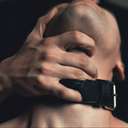
What I was that morning, though I had not yet learned to think of myself so, was a branded animal nine days made. The law’s single letter stood new on my left flank, risen and shining, weeping a thin clear weep where the oil found it. Under the jaw the collar had galled a raw ring that stung when I swallowed, and where the cold had caught me the gooseflesh would not go down, so that I stood pebbled and shaking and could not stop the shaking, and of everything bare on me it was the shaking I could least bear to be seen. A porter came along the rail and read the chip in each of us in turn, the bead they had set under the skin at the nape, at the forge, with the brand: a small electric chirp, one beast logged, then the next, because every animal at Maitland & Roe is traceable from that forge to the gate of whatever house will take it, and a man buys here with a clear conscience and full provenance. I had been in the country eleven weeks. I had been a slave nine days.
I should tell you, because it matters to everything that came after, that I had earned it.
I want to be exact. I jumped my ship and stayed in a country that forbids it, and they took me with a little powder I had bought in a portside room to make one cold week shorter. A folly, a nothing, the kind a free man forgets by spring. This country does not forget it. Both offences carry the one sentence, and the sentence is for life. I had read the notices myself, in three languages, at every customs house on the coast, and thought, as men do, that notices are for other men.
A man can lie in the straw and call himself the victim of an enormous wrong. Many did, around me, and it ate them. I had seen at the rail that morning what it leaves of a man in the end: an older one, grey at the temple, who had given up the weeping and the shame hours since and stood with a flat dead stare fixed on nothing, and I could not look at him long, for in his stillness was the country they were walking me into. I would not. I had walked onto that road on my own feet, and a man who has done that is owed the one dignity left him: to have earned where it leads. So I took the collar as mine. Not a thing done to me: a thing I had bought, as surely as I bought the powder. It is a colder comfort than innocence, and a steadier one, and it let me sleep when the men on either side of me wept the night through.
When my turn came they unbarred the pen and two handlers walked me up onto the platform, and there, for the last time in my life that it would do me any good, I fought them.
I am a big man, and was a bigger one then, and for a moment I had the better of it: I got an arm loose and put one of them hard into the rail, and the yard went very quiet and interested, the way a yard does when stock it owns forgets itself. It did not last. A third man came up behind me with the short strap they keep for exactly this, and laid three strokes across the backs of my thighs faster than I could turn to him. Each was a bright line of fire that buckled the leg before the pain had a name, and by the third I was down on the boards on one knee with my own weight gone over to them, and the choice the whole yard had been waiting for me to understand arrived in my body before it reached my mind: there was the strap, and there was obedience, and there would never again be anything else. I stopped. They stood me up and made me kneel and rise again to order, and a handler set his boot and his voice to me together and gave the command they give every new animal on that platform, the first two words of my new grammar.
“Stand. Display.”
I learned later that there is a posture to it: feet apart, hands laced behind the neck, chin up, the body opened for the look. I did not know it yet, and the handler arranged me into it with his hands, the way you pose a mannequin, tilting my chin with one finger, kicking my heels wider, drawing my elbows back until the chest came out, and the watching men made the small appreciative sounds that I would spend years learning to be proud of. I was not proud of it that morning. That morning I stood oiled and opened in the sun with the tears running off my jaw, and was looked at.
They came up in ones and twos to handle me. I will not catalogue their hands: a weighing of the sac, the grey-coated woman turning me, parting me, writing it down, a thumb hooked in my jaw to count the teeth, and the taste of that thumb, soap and metal and another man’s skin, I have in my mouth yet. What stayed with me, though, was not the handling but the arithmetic of it: the feeling of being read like a column of figures and priced part by part, sound teeth and good legs, the foreskin a small deduction and the temper a larger one, until the man I had been was gone and there was only a sum, oiled and shaking in the sun, waiting to be totalled. I will be honest, since I have promised myself honesty here if nothing else: a part of me was grateful even for that. There is a terrible ease in being reduced to a thing that can be valued, a life narrowed all at once to a single task a man cannot fail. To be looked at. To be handled. To bear it.
He was the last to come. Not the last in the line of buyers, but the last that would ever matter to me. The final one. After him no other hand would take my lead as long as I lived, but I did not know that yet, standing in the sun, and neither, I think, did he.
I did not know his name then. I learned it on the road home, and have said it more times since than I could count. But I did not know it on the platform, and so I will keep it from you a little longer, as it was kept from me. He was perhaps forty, slight beside the others, plainly and very well dressed. He came up the steps without hurry, stood before me, and for a while did nothing but look.
I had been looked at all morning. This was not looking. The others had appraised a carcass and moved on. This man was interested, in me, it seemed, in the particular fact of my body: my face, my hands, the long muscles of the back, the brand and what it had cost me to wear it. He studied me slowly, with an attention I had not had from any creature, free or otherwise, in a long time, and did not know how to refuse, and did not want to. He did not pry my mouth or weigh me in his palm. He came round once and laid his hand flat and open over the raw brand on my flank, not pressing, only covering it, as one stills a small hurt, and when the handler at my shoulder caught the change in my face and raised the strap, the man lifted a single finger, not troubling to look at him, and the strap came down unswung.
Then he spoke to me, low and level, meant for me and not for the yard. I will not pretend I remember the words. But I have always believed he asked me my age, the kind of thing he would come to do, and no one else that morning had asked me anything at all. Whatever it was, he said it calmly, and no one had spoken to me calmly since the dock, and the sound of it undid something the strap had not been able to reach. To my shame, and it was shame then, though it took me years to call it anything kinder, my body answered the calm and the covering hand as a dog answers a hand, as the body answers what the mind would sooner die than ask for, and he saw it, and did not smile, and took his hand away.
What to call what passed in me then, I have never settled. I have had years to find the word and have kept none. I know only that his hand stilled the shaking the strap could not, and that I was grateful, in the bottomless, shaming way of an animal that finds one warm hand in a hard place. That was all, on the block. It was a great deal.
He bought me that morning. But that is the sentence the wrong way round. He bought me: that is his part of it, and the smaller part. Mine was the other voice of the verb. I was bought. For money. I have wondered since which moment it was that I stopped being a man and became a thing, and it was none of the ones you would name: not the judge’s order, not the iron at the forge, not the bead of the chip under my skin. Those unmade me in law and marked the animal, but some last private acre of me had stayed my own through all of it. The sale took that. A sum was counted out and a hand closed over it, and in the breath of that exchange my body passed from no one’s keeping into his. A price had been paid, and I was the thing it was paid for. Nothing done to me before that went so deep. Nothing after it ever had to.
What it cost him I did not learn until later: a great deal of money, I am told, for an unbroken import with his foreskin still on and a temper still in him, and he did not haggle, which the house found remarkable. The papers passed, and the porter scanned the chip one last time into the new column, and a handler clipped a lead to my collar and put the end of it in the gloved hand of the man who had bought me, who had not, in all of it, told me his name or asked for mine. He had not yet given me the one he meant me to wear. That came later, on the road, and is the next of what I have to tell.
He led me down off the platform and out through the white gate under the clean black lettering, into the noise of the lower city and the rest of my life, and I went at his shoulder with my eyes down and my heart going like a hooked fish, and I have called that morning, in all the years since, the best thing that ever happened to me.
Let me be plain, since you will not believe me otherwise. The best thing that ever happened to me, in all my life, free or owned, was the man at the other end of my lead. I did not know it on the block. I learned it slowly, the way you learn the worth of water, by the lack of it in others. He was not cruel. He was exacting, and fair, and never asked more than was required, and gave a reason for what he asked, and made something of me, as a man makes something of a raw colt he judges worth the trouble. I have since seen what the other kind of master does to the men beneath him, and understood at last that to be owned by a good one is a grace most slaves never taste: a luck so far past deserving that a man may spend his whole life grateful for it, and call the spending happiness.
I want you to understand that I mean it.