He named me on the road.
I had come out of Maitland & Roe with no name. They had taken the old one at the forge and set me in their books as a number. But a thing that is kept must be called something, the way a dog is taught a sound to come to. He gave me my sound that afternoon, on the road north, and I have come to it ever since.
But I have got ahead of the road, and the road is worth taking in its order, because there was no foot of it I would not come to know.
His trap was waiting in the lane, a neat two-wheeled thing, very plain, very well made, with a slave already standing between the shafts. I had seen such men in harness in my weeks in Valcourt, at a distance, in the traffic, without understanding what I looked at. I had never stood close to one.
He was a magnificent animal. I use the word with care: it is the trade’s word, and it fit him. A big man, near my own size, shaved smooth and oiled until he threw back the afternoon light, the long muscles of him standing under the sheen.
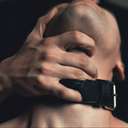
He wore a bridle, the bit drawn back between his teeth so the corners of his mouth were pulled into the shape of a grin that was not one. Below that, a broad padded collar, and a harness of oiled black straps crossing his chest and running back to the shafts. And below that again, a thing I had no word for then: a cinch of the same black leather that bound his sex up tight and high and held it there, on show, like a prize at a fair.
He stood with his head lowered and his weight settled, sweat already starting on him in the heat, and waited the way a horse waits, and no one in the lane spared him a look.
Poor devil, I thought. And I would not let myself think, though it lay plainly there to be thought, that I stood as bare as he stood, oiled as he was, the brand still wet on my flank and a lead at my throat. That the only things between his state and mine were the harness and the schooling. And that both were already on their way to me.
I looked at him with the last of my free man’s pity and felt myself, God forgive me, the better of us two.
I did not understand then that within the year I would wear that gear and stand in those shafts, and draw my master through these same streets with my own sex cinched up and shown and the sweat running off me, and run at the side of just such a slave and count it an honour, and be ashamed of none of it, but proud, proud of the very straps.
I could tell you the wanting was already in me, there in the lane, that I looked at his harness and some buried part of me coveted it. The man I am now would half-believe it. It makes a tidier story, and a tidy story is the thing we want most from our griefs.
But it would be a lie, and I have promised you none. In the lane I felt only pity, and my aching legs, and a free man’s certainty that the creature in the shafts and I were two different orders of thing. The wanting came later. It had to be taught to me, and I had good teachers.
He did not mount at once. He tended his own stock with his own hands, and he went to the pony first: he uncapped a flask and held it to the bitted mouth, tilting it slow. The pony could not manage around the bit and slopped half of it down his chin, and my owner said, low, “Easy. Not so fast, boy,” and worked two fingers in past the iron to help the water down, patient as a man is with a beast he values. When the pony had drunk he laid his hand flat on the wet muzzle and patted it, twice, and the pony leaned the smallest amount into the hand.
I saw that. I did not yet know what to make of it.
Then he came to me. He held the flask to my mouth himself, a thing he might have left to any servant and did not, and I drank, and the water was warm and tasted of metal and was the best thing I had had in nine days, and his hand stayed steady under my jaw the while.
When he had let me drink he looked at me as he had on the block, really looked, and said, in the voice you would use to remark on the weather: “You are the Norwegian.”
It was not a question, and I did not yet know that I was now to answer everything, so I said nothing. He flicked his cane against me, not hard, a tap such as you would give a beast to wake it to its business, and said, “You answer me, boy. ‘Yes, Master.’”
“Yes, Master.” The first time I said it. It came out thick and wrong in a foreigner’s mouth, and some part of me died to hear it. And another part, that I am less proud of, eased, because a thing had been asked that I could do, and I had done it, and nothing more was wanted.
“Norwegian,” he said again, pleased, as a man is pleased to have a thing confirmed that he paid for.
“Then you’ll be Thor.”
He said it lightly, the way you name a big fair dog for the look of it, for the north, for the size, a thunder-god put between the shafts of a market cart. I do not think he weighed it a moment. I have weighed it many years.
It cost him nothing. It went into me like a nail, and something in me sat down quietly and did not get up again.
They had taken my old name at the forge and left a hole, and a man can carry a hole in him a long way without falling. He filled it now, though not with what was taken, which had gone north with the man who once answered to it, but with a name of his own choosing: the tag for the ear, as the brand was the tag for the eye and the chip the tag for the scanner. A sound I would answer to, and come to, and listen for in his mouth, and where they began on the rest of me, the slow part, the part I would help with.
I knew only, in the lane, a small and shameful easing: that I was someone again, even if the someone was his.
His own name, which I give you now, since I have made you wait as I was made to wait, was Henri Duval. But I never called him that. To me he was Master, only and always. And the few times I have set it on paper since, my hand has felt the trespass of it, as if I had reached above my place even here.
Before we took the road he had us emptied. “We’ve a long road,” he said, “and I don’t care to stop.”
The pony went first, and went without thought, a hard, steaming stream that rang on the cobbles and ran in a fork between the wheels. He blew once through his nose at the ease of it, and shifted his weight, and was done. An animal doing an animal’s business in the street. Not a head turned.
That was the thing I could not get past, then: that no head turned. The traffic went by. A lady in a passing trap looked through me as through a lamp-post. This was nothing, the daily furniture of their streets, a beast voided before a journey.
I hesitated, being eleven weeks out of a country where a man did not do such a thing in the open, and his cane woke once against my back, and I learned that hesitation is itself an answer, and the wrong one. So I began.
And reached, without thinking, to take myself in hand, as I had done all my life. His cane caught my wrist, sharp, and the Master said, not unkindly, “No hands, boy. You’ll want to get used to that.”
So I finished as a beast finishes, with nothing to guide it, and the stream went where it would, down my own thigh, over my foot, hot and then cold.
I felt it on my leg the whole hour to Beauvert, drying as I ran, ashamed of it at every step. And here is a thing I am not proud to set down, but I promised you the truth: in time I came to give thanks for the cinch, that black strap that binds a pony’s sex up tight and aims it, because a pony with no hands may empty himself on the road and keep himself clean. There is no mercy a slave will not learn to be grateful for. Even the ones that are only a better harness.
He clipped my lead to the ring at the back of the trap, then mounted and took the reins, for he liked to drive, and liked his stock to feel his own hand on the rein. A click of his tongue, and the pony leaned into the shafts. We came out of the lane, and where the streets opened he put the pony to a trot, and I ran behind at the tail of the cart, the road going by under me, my legs not yet knowing the work that would be asked of them.
Beauvert lay an hour north of the city, and I came to it at the tail of the trap with my legs gone to water and the road’s dust caked into the oil on my shins. I will tell you what the place was, because you will have heard of it even if you never passed its gate. It was famous, in its quiet way. It was beautiful, and I want to be plain about that, because nothing I came to know there afterward ever made it less so.
You came up a long avenue of limes to a low white house with green shutters, and round it lay the most tended ground I had ever seen: orchards in their ruled ranks, walled gardens, glasshouses taking the last of the sun, a long pond with birds settled on it for the evening.
The Master kept no motor on the place. He was proud of that, and it was written up in the journals that drove out to admire him: everything at Beauvert moved by hand, or by hoof, or by the legs of his slaves, and grew in its own soil, and fed itself, and wasted nothing.
Nothing at all. Not the orchard prunings nor the kitchen peelings nor what was sluiced each dawn from the drains beneath us: all of it turned back into the gardens, so that the place ran round on itself in a clean closed circle and took nothing from the earth it did not give again.
They had given him a medal for it the year before I came. People drove out to see how a great house might be kept in a modern and a tender conscience. They were shown the orchards and the glasshouses and the swept stable-yard. They were not, as a rule, shown us, though we were the turning of the wheel. But you do not take visitors to see the inside of a machine.
And so, when I came to it, I came to a flawless and empty place. We came up the long avenue at a trot and into the forecourt, and I did not see one of my own kind. No bent back in the gardens, no harness in the yard, nothing, only swept gravel and clipped box and a serene shut house, the way a stage is empty before the curtain.
The one who came down the steps to meet us wore clothes, though barely: a brief sleeveless tunic, shorts, sandals. Even so little cloth on a slave startled me more, somehow, than all the nakedness had. The collar was at his throat under it, as it was at mine, and that comes off for no one, clothed or bare. On his forearm stood the same letter they had burned on me, set where no cloth could cover it: a slave’s brand may never be hidden, I would learn, but must stand always in open sight, that any free eye might know him at a glance for what he was. This was Milo, though I had not his name yet. The house dressed its presentable few to be looked at, not to be decent, and kept the rest naked and out of sight.
And the rest were many, the better part of two thousand, who ran the orchards and the glasshouses and the fields and the kitchens and the stables by hand, every hour of the light, and whom the whole art of the place was to keep from showing.
What that hidden labour looked like I would not learn for some weeks. When I did, I would be standing in it: the long lines of us bent over the rows from first light to last, naked, the sweat running off us into the famous soil, and over it all a silence I have met nowhere else on earth. For at Beauvert a slave at work did not speak, nor groan, nor cry out even under the lash. The only sounds in all that green were the breathing of two thousand men and the handlers’ whips, keeping the time.
That is the quiet the visitors came to praise. That is what a tender conscience sounds like, heard close.
But that is further on. On my first evening I saw a garden, and a still white house, and birds settling on the pond, and I was grateful for the peace of it, and did not yet know what the peace was made of.
I thought it the loveliest place I had ever stood in. I think so still. I have never been able to make that thought sit quietly beside the others.
Milo took me down to the stable-yard.
He was old, old for a slave, which is to say he had outlasted the things that use a slave up, and gone grey in the house instead of under the sun. He looked me over once, head to foot, without a word, as you check a delivery has come whole and undamaged, and found me sound.
He had a stillness to him that I would come to lean on more than was wise. Nothing hurried him. Nothing in that yard happened that he had not seen ten thousand times, and his hands had the gentleness that comes not from kindness but from long sureness, which is a thing you can mistake for kindness for years, and I did.
The pony was already there, at the wash-rail, my own trap-pony, the magnificent animal I had pitied in the lane from the height of my own bare and branded body. Jack. They had brought him in from the shafts, and two grooms were sluicing the long run’s sweat and oil off his flanks while he stood with his head down and let them, the way he let everything. They set me at the rail beside him, and when the first cold water hit me, he turned his head and looked at me.
It does not sound like much. You have not been where I had been. Not the overseers, not the buyers, not one free face in eleven weeks had looked at me as though there were a man behind the brand. This broken animal beside me did. He held my eye a moment. Something passed in it that was not pity and was not hunger, only here is another of us. And then a groom took his jaw and turned it to the front, for at Beauvert a slave’s eyes belonged on nothing but his work.
But it had happened: the creature I had pitied from my own height had looked at me as a man looks at a man, the first thing in all that country given to me and not taken, the beginning of the one good thing the Master never owned, never gave and so could never take, though in the end I let it go cheaply enough myself.
What was done to me at that rail was done to every slave there every morning of his life, and would be done to me past all counting, so I will tell it the once. I was put to my knees on the wet stone beside him and washed, not gently, not cruelly, but to a finish, as you wash a thing you mean to keep using.
The grooms’ hands went over me with the cloth and the cold water, careful at the new brand on my flank, careful at the galled ring under my jaw, and I was grateful for the care and ashamed of the gratitude both.
Then Milo shaved me. He took the razor over my chest and my throat, my belly, the insides of my thighs, my groin, the cheeks of my arse, with that unhurried sureness that frightened me worse than any roughness could have, because roughness I could have set my teeth against and this I could not. It asked nothing of me but to hold still and be tended, and there is a terrible softness in being tended.
I have told no one this. Somewhere under the razor, with the old man’s hand moving sure and slow across me, Jack a hand’s breadth off at the rail with the water running silver off him, my whole skin laid bare and oiled and nothing wanted of me but to kneel and be made ready, somewhere in it I rose.
I, who an hour before had carried a free man’s measure of rage: there it stood now, with no hand laid on me and no will of mine in it, and the shame of it went through me cold as the water.
And I did a thing I had not done in the lane. There he had been a state I pitied, a warning of what waited for me. Now, with my own body risen and shameless against me, I turned my eyes onto him to be away from myself, and for the first time looked at him as a body and not a fate: a hand’s breadth off, shaved as I was being shaved, the water running silver down the long back and the heavy shoulders, the sex bare and smooth as mine was now made bare. I looked, and could not have told you what the looking was. It was not pity any longer, and it was not yet the thing it would become. Only that my eyes had gone to him the way my body had risen under the razor, before I had a word for either, and that the looking shamed me worse than the rising.
Milo had seen it on a hundred new men and took no more notice than of a colt that fidgets under the brush. He did not remark on it. He did not have to. My body had begun, before my mind had any word for it, to learn what it was now for. And Jack, beside me, did not turn his head again. But I have always thought he knew.
By the time Milo set down the cloth the light had gone blue in the doorway. I was clean, and bare, and oiled, and so tired I could have laid my cheek on the wet stone and slept. But I was not yet to sleep. There was one thing more that was asked of a new slave at Beauvert before he was given his straw. Asked, you understand: not cruelty, but the order of the house, the same for every man who had ever come through that yard. And Milo, who had done it to better men than me, dried his hands on his apron and took me to it.